Robots that move fast — and stay safe around people.
Fihan Edge gives autonomous robots the judgement to move through busy, unpredictable spaces. A dedicated safety layer double-checks every move, so the robot is quick when it can be and careful when it must be.
See, decide, stay safe.
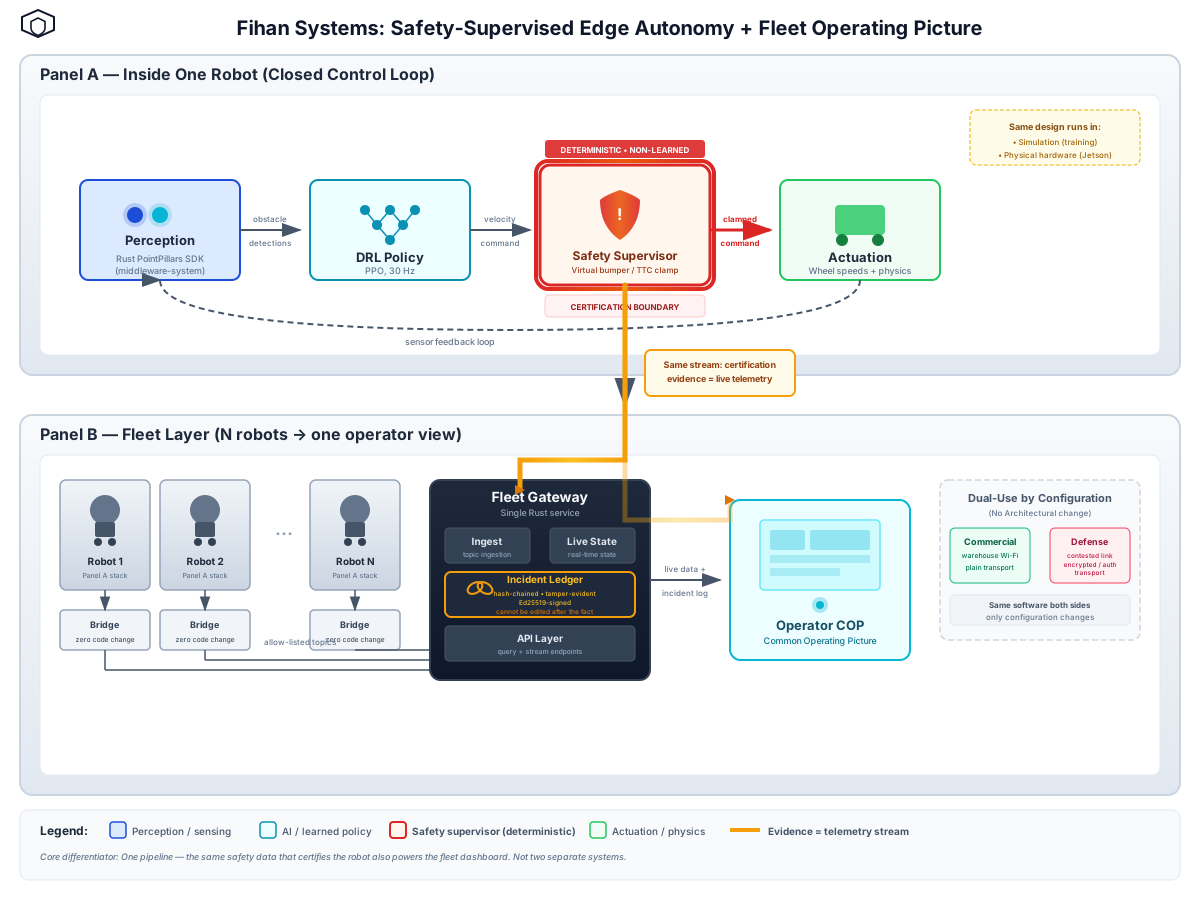
Every Fihan Edge robot does three things, continuously — and the third one always has the final say.
AI Policy
Proposes the next move from what it sees
Fihan Safety Layer
Checks the move against the space around the robot
MonitoringWheels / Actuators
Executes only what the safety layer allows
It understands what's around it — instantly.
Cameras and laser sensors give the robot a live, three-dimensional picture of its surroundings. Fihan Edge makes sense of that flood of data fast enough to react in real time, even on the small computer mounted on the robot itself.
- Builds a live picture of people, shelves and obstacles
- Fast enough to react while moving at speed
- All processing happens on the robot — nothing sent to the cloud
It has practised thousands of situations.
Before a robot ever reaches your floor, Fihan Edge has rehearsed in a realistic simulator across thousands of scenarios — crowded aisles, sudden obstacles, near-misses. It learns smooth, sensible behaviour, and it learns to slow down when it isn't sure.
- Trained in simulation across thousands of scenarios
- Handles crowds, tight spaces and unexpected obstacles
- Eases off the speed whenever it's uncertain
A safety layer it can never overrule.
Every movement the robot wants to make is checked by a separate safety layer before it reaches the wheels. If a move would bring it too close to a person or object, the safety layer slows or stops it. This check is simple, predictable, and impossible for the robot to skip — we call it the Fihan Safe House.
- An independent check on every single movement
- Slows or stops the robot before it gets too close
- Predictable and tamper-proof — the robot cannot override it
It rehearses first, then it works.
A robot learns in a realistic simulator long before it reaches your floor — and the safety layer travels with it into the real world.
The Zero-Crash Guarantee.
Most robots hand the artificial-intelligence's decision straight to the motors. Fihan Edge doesn't. Powered by LS-Stat confidence scoring, a separate, predictable safety layer sits between the decision and the wheels and checks every move. If the AI is uncertain, the safety layer tightens the margins, providing a clear, dependable boundary that safety reviewers and industrial standards (ISO 3691-4) require.
For the engineers.
For the engineers: Fihan Edge is a Rust-native runtime that runs the full perception-and-control loop on the device, with deterministic, bounded timing suitable for safety certification. The timing, memory and power contracts we design against are covered in a technical briefing rather than published here — they are targets tied to specific silicon, and a number without its hardware and its measurement method is not worth much.
- Built in Rust — no garbage-collection pauses, so timing stays predictable
- ‘Hilbert curve’ point ordering removes the usual preprocessing bottleneck
- Policies trained with PPO / MAPPO in NVIDIA IsaacLab, exported to ONNX
- Confidence scoring (LS-Stat) tightens the safety margins when perception is uncertain
- Integrates as a Rust SDK, a C library, or a ROS 2 (Humble) node
- Designed toward IEC 61508, ISO 3691-4 and DO-178C safety standards
Timing, memory and power contracts are shared in a technical briefing. They are engineering targets rather than measured results, and each one assumes specific silicon. We would rather walk you through the target, the hardware it assumes and where our bench sits today than post a number stripped of its context.
Want to see it on your robot?
Tell us about your platform and where it operates — we'll walk you through what Fihan Edge would do for it.